- Home
- /
- Administration
- /
- Admin & Deploy
- /
- SAS university Edition Deployment Wizard - Choosing a deployment direc...
- RSS Feed
- Mark Topic as New
- Mark Topic as Read
- Float this Topic for Current User
- Bookmark
- Subscribe
- Mute
- Printer Friendly Page


- Mark as New
- Bookmark
- Subscribe
- Mute
- RSS Feed
- Permalink
- Report Inappropriate Content
@DWimbish you have already posted this question.
please do not spam the community with duplicated postings.


- Mark as New
- Bookmark
- Subscribe
- Mute
- RSS Feed
- Permalink
- Report Inappropriate Content
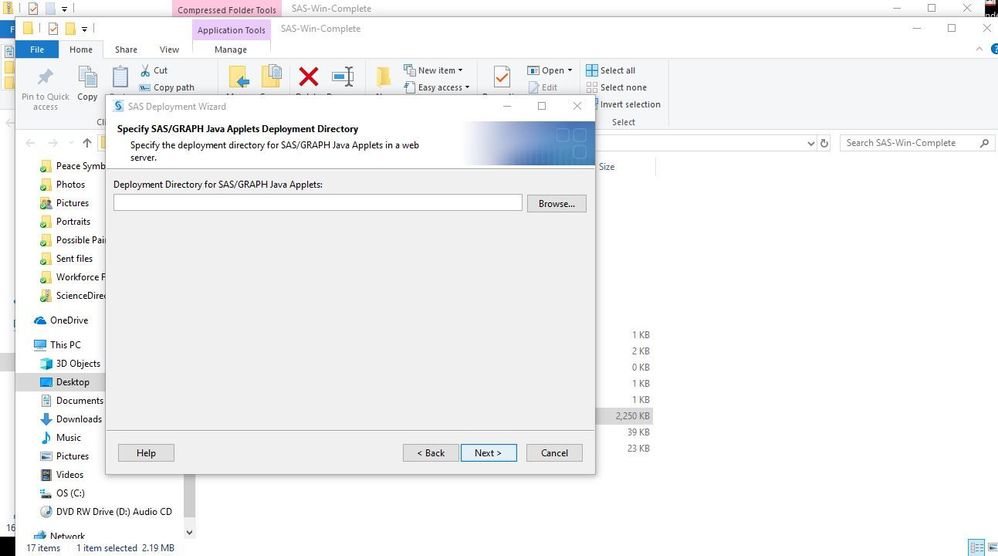
Hi. I am trying to install the university edition of SAS on a Windows single use machine using the SAS Deployment Wizard. I got to the screen that asks me to "specify the deployment directory for SAS/GRAPH Java Applets in a web server." There is a browse button, and it wants me to go to a specific place and choose a directory. I have no idea what I am doing here. I don't know what to look for or where to look for it. Help?


- Mark as New
- Bookmark
- Subscribe
- Mute
- RSS Feed
- Permalink
- Report Inappropriate Content
AFAIK, University Edition is just a .ova file to be opened with Virtualbox, no Deployment Wizard necessary?
- Mark as New
- Bookmark
- Subscribe
- Mute
- RSS Feed
- Permalink
- Report Inappropriate Content
I've posted a picture of the message. It looks like the version says SAS-Win-Complete. Perhaps it is a different version than I thought?
- Mark as New
- Bookmark
- Subscribe
- Mute
- RSS Feed
- Permalink
- Report Inappropriate Content
From where did you get it? Is this a version licensed by your university for distribution to the students?
- Mark as New
- Bookmark
- Subscribe
- Mute
- RSS Feed
- Permalink
- Report Inappropriate Content
Yes. There is a link on the University Website to download it.
- Mark as New
- Bookmark
- Subscribe
- Mute
- RSS Feed
- Permalink
- Report Inappropriate Content
According to https://www.gvsu.edu/cms4/asset/778479D3-07DF-084E-09FD89BDE51017EA/sas_9.4_installation_tips_--_upd..., you should use
C:\program files\SASHome\
So it is the same base directory that is used for all SAS installations on Windows.
- Mark as New
- Bookmark
- Subscribe
- Mute
- RSS Feed
- Permalink
- Report Inappropriate Content
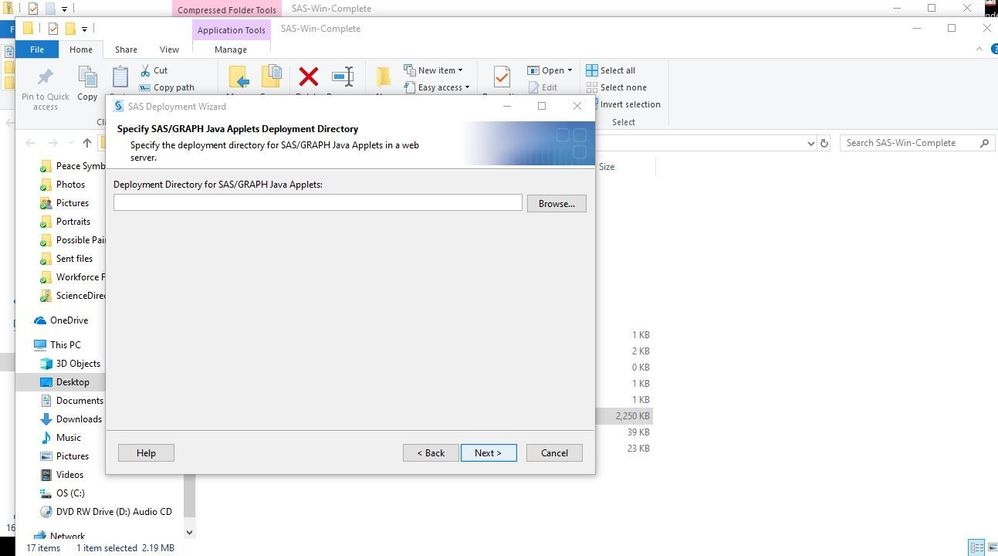
Hi. I am trying to install the SAS-Win-Complete on a Windows single use machine using the SAS Deployment Wizard. I got to the screen that asks me to "specify the deployment directory for SAS/GRAPH Java Applets in a web server." There is a browse button, and it wants me to go to a specific place and choose a directory. I have no idea what I am doing here. I don't know what to look for or where to look for it. Help?


- Mark as New
- Bookmark
- Subscribe
- Mute
- RSS Feed
- Permalink
- Report Inappropriate Content
Hi ,
Just give SAS home path and go a head with installation and see.
C:\Program Files\SASHome\SASGRAPHJavaApplets
Thanks,
Shiva
- Mark as New
- Bookmark
- Subscribe
- Mute
- RSS Feed
- Permalink
- Report Inappropriate Content
I merged the two threads, and will move the whole to Admin & Deploy.

- Live Webinar: Unlocking Value With Managed Cloud Services | 16-Jun-2026
- Ask the Expert: Can Agents Reduce Planning Friction in CPG Supply Chains? | 16-Jun-2026
- Ask the Expert: Mit KI zur Höchstleistung: SAS Studio Copilot in Aktion! | 25-Jun-2026
- Ask the Expert: Get Meaningful Results With New Features in SAS Customer Intelligence 360 | 25-Jun-2026
- Ask the Expert: Modern, offen, skalierbar: Datenarchitektur mit SAS®Viya | 09-Jul-2026
- MinnSUG 2026 Annual SAS Conference | 22-Jul-2026
Learn how to explore data assets, create new data discovery agents, schedule data discovery agents, and much more.
Find more tutorials on the SAS Users YouTube channel.
-
9 replies
-
05-18-2019 11:48 AM
-
10072 views
-
0 likes
-
4 in conversation
-


