- Home
- /
- Programming
- /
- Programming
- /
- Issue with dataset + operator
- RSS Feed
- Mark Topic as New
- Mark Topic as Read
- Float this Topic for Current User
- Bookmark
- Subscribe
- Mute
- Printer Friendly Page


- Mark as New
- Bookmark
- Subscribe
- Mute
- RSS Feed
- Permalink
- Report Inappropriate Content
data s2;
retain sum;
assign = sum;
sum + 1;
proc print; run;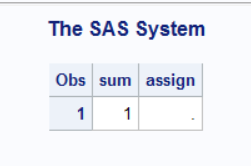
*Anyone knows why here:*
assign=. whereas
sum=1
because when we apply the + operator with any missing value the final result should be. (missing)
Accepted Solutions


- Mark as New
- Bookmark
- Subscribe
- Mute
- RSS Feed
- Permalink
- Report Inappropriate Content
If you use a variable as the target in a SUM statement then the variable will be retained and it will default to initialize to zero , UNLESS YOU TELL TO INITIALIZE TO SOMETHING ELSE.
Remove the RETAIN statement. Of tell it to initialize to zero instead of missing.
19   data s2;
20   retain sum;
21   assign = sum;
22   sum + 1;
23   put (_all_) (=);
24   run;

sum=1 assign=.
NOTE: The data set WORK.S2 has 1 observations and 2 variables.
NOTE: DATA statement used (Total process time):
      real time           0.03 seconds
      cpu time            0.04 seconds


25   data s2;
26   assign = sum;
27   sum + 1;
28   put (_all_) (=);
29   run;

assign=0 sum=1
NOTE: The data set WORK.S2 has 1 observations and 2 variables.
NOTE: DATA statement used (Total process time):
      real time           0.01 seconds
      cpu time            0.03 seconds


30   data s2;
31   retain sum 100;
32   assign = sum;
33   sum + 1;
34   put (_all_) (=);
35   run;

sum=101 assign=100
NOTE: The data set WORK.S2 has 1 observations and 2 variables.
NOTE: DATA statement used (Total process time):
      real time           0.00 seconds
      cpu time            0.00 seconds


- Mark as New
- Bookmark
- Subscribe
- Mute
- RSS Feed
- Permalink
- Report Inappropriate Content
The SUM statement documentation says the variable (in this case SUM) is initialized to zero. So sum+1 is not missing.
Paige Miller

- Mark as New
- Bookmark
- Subscribe
- Mute
- RSS Feed
- Permalink
- Report Inappropriate Content
Sum Operator
Sum Statement
Sum Function
They each works slightly differently.
- Mark as New
- Bookmark
- Subscribe
- Mute
- RSS Feed
- Permalink
- Report Inappropriate Content
Please explain
- Mark as New
- Bookmark
- Subscribe
- Mute
- RSS Feed
- Permalink
- Report Inappropriate Content
If you use a variable as the target in a SUM statement then the variable will be retained and it will default to initialize to zero , UNLESS YOU TELL TO INITIALIZE TO SOMETHING ELSE.
Remove the RETAIN statement. Of tell it to initialize to zero instead of missing.
19   data s2;
20   retain sum;
21   assign = sum;
22   sum + 1;
23   put (_all_) (=);
24   run;

sum=1 assign=.
NOTE: The data set WORK.S2 has 1 observations and 2 variables.
NOTE: DATA statement used (Total process time):
      real time           0.03 seconds
      cpu time            0.04 seconds


25   data s2;
26   assign = sum;
27   sum + 1;
28   put (_all_) (=);
29   run;

assign=0 sum=1
NOTE: The data set WORK.S2 has 1 observations and 2 variables.
NOTE: DATA statement used (Total process time):
      real time           0.01 seconds
      cpu time            0.03 seconds


30   data s2;
31   retain sum 100;
32   assign = sum;
33   sum + 1;
34   put (_all_) (=);
35   run;

sum=101 assign=100
NOTE: The data set WORK.S2 has 1 observations and 2 variables.
NOTE: DATA statement used (Total process time):
      real time           0.00 seconds
      cpu time            0.00 seconds

Call for content now open!
It's your turn to help shape SAS Innovate 2027. Share your expertise and inspire the SAS community.
Learn how use the CAT functions in SAS to join values from multiple variables into a single value.

Find more tutorials on the SAS Users YouTube channel.
SAS Training: Just a Click Away
Ready to level-up your skills? Choose your own adventure.
-
4 replies
-
06-23-2023 01:04 PM
-
2604 views
-
2 likes
-
4 in conversation
-


