- Home
- /
- Programming
- /
- Programming
- /
- how many times a specific time of day occurs in a datetime interval
- RSS Feed
- Mark Topic as New
- Mark Topic as Read
- Float this Topic for Current User
- Bookmark
- Subscribe
- Mute
- Printer Friendly Page


- Mark as New
- Bookmark
- Subscribe
- Mute
- RSS Feed
- Permalink
- Report Inappropriate Content
How do you count the number of times a specific time of day (for example 23:59, i.e. 11:59PM) occurs in a datetime interval?
data have;
	input ID $ begDate:datetime13. endDate:datetime13.;
	format begDate endDate datetime13.;
cards;
aaa 10NOV19:01:49 10NOV19:03:49
bbb 10NOV19:22:49 11NOV19:03:49
ccc 10NOV19:22:49 12NOV19:03:49
	;
run;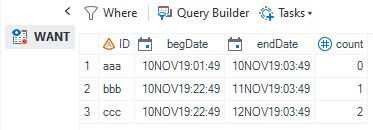
Accepted Solutions


- Mark as New
- Bookmark
- Subscribe
- Mute
- RSS Feed
- Permalink
- Report Inappropriate Content
If your test is to see how many times midnight is in the interval, then the INTCK function does the job.
data want;
    set have;
    incl_midnight = intck('dtday',begdate,enddate);
run;
If you want some other time, let's say 10:45pm, I believe (untested), you subtract '22:45:00't from both begdate and enddate and then use the INTCK function.
Paige Miller


- Mark as New
- Bookmark
- Subscribe
- Mute
- RSS Feed
- Permalink
- Report Inappropriate Content
Hi @dataMart87 , it may depend on what your use case is but an easy method would be to use the TIMEPART() function then do a count distinct. See example below
*Load data;
data have;
	input ID $ begDate:datetime13. endDate:datetime13.;
	format begDate endDate datetime13.;
cards;
aaa 10NOV19:01:49 10NOV19:03:49
bbb 10NOV19:22:49 11NOV19:03:49
ccc 10NOV19:22:49 12NOV19:03:49
	;
run;

*Extract time;
data want;
set have;
begTimePart = timepart(begDate);
format begTimePart time.;
run;

*Get count of time appearance;
proc sql;select distinct begTimePart,count(begTimePart)
from work.want group by begTimePart;quit;- Mark as New
- Bookmark
- Subscribe
- Mute
- RSS Feed
- Permalink
- Report Inappropriate Content
If your test is to see how many times midnight is in the interval, then the INTCK function does the job.
data want;
    set have;
    incl_midnight = intck('dtday',begdate,enddate);
run;
If you want some other time, let's say 10:45pm, I believe (untested), you subtract '22:45:00't from both begdate and enddate and then use the INTCK function.
Paige Miller

Catch up on SAS Innovate 2026
Nearly 200 sessions are now available on demand in the Innovate Hub.
Watch Now →Learn how use the CAT functions in SAS to join values from multiple variables into a single value.

Find more tutorials on the SAS Users YouTube channel.
SAS Training: Just a Click Away
Ready to level-up your skills? Choose your own adventure.
-
2 replies
-
01-24-2022 04:10 PM
-
1514 views
-
0 likes
-
3 in conversation
-


