Turn on suggestions
Auto-suggest helps you quickly narrow down your search results by suggesting possible matches as you type.
Showing results for
- Home
- /
- Programming
- /
- Programming
- /
- Retain Multiple Variables
Options
- RSS Feed
- Mark Topic as New
- Mark Topic as Read
- Float this Topic for Current User
- Bookmark
- Subscribe
- Mute
- Printer Friendly Page


Quartz | Level 8
- Mark as New
- Bookmark
- Subscribe
- Mute
- RSS Feed
- Permalink
- Report Inappropriate Content
Posted 09-05-2016 01:25 PM
(3753 views)
I want to retain all the variables. Please see the raw data and desired data below -
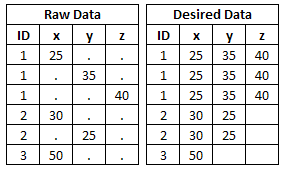
data temp;
input ID x y z;
cards;
1 25 . .
1 . 35 .
1 . . 40
2 30 . .
2 . 25 .
3 50 . .
;
run;

data temp2;
set temp;
by ID;
retain x1 0;
if first.ID then X1=x;
else X1=X1;
run;
I have done it for variable x but i am unable to do it for other variables.
2 REPLIES 2


Opal | Level 21
- Mark as New
- Bookmark
- Subscribe
- Mute
- RSS Feed
- Permalink
- Report Inappropriate Content
A double DO UNTIL() can perform this operation:
data temp;
input ID x y z;
cards;
1 25 . .
1 . 35 .
1 . . 40
2 30 . .
2 . 25 .
3 50 . .
;

data want;
array _a{3} x y z;
array _b{3};
do until(last.ID);
    set temp; by ID;
    do i = 1 to dim(_a);
        _b{i} = coalesce(_b{i}, _a{i});
        end;
    end;
do until(last.ID);
    set temp; by ID;
    do i = 1 to dim(_a);
        _a{i} = _b{i};
        end;
    output;
    end;
drop i _b:;
run;

proc print; run;
PG


Super User
- Mark as New
- Bookmark
- Subscribe
- Mute
- RSS Feed
- Permalink
- Report Inappropriate Content
data temp;
input ID x y z;
cards;
1 25 . .
1 . 35 .
1 . . 40
2 30 . .
2 . 25 .
3 50 . .
;
run;
proc means data=temp noprint;
by id;
var x y z ;
output out=temp1 sum=;
run;
data want;
 set temp1(drop=_type_);
 do i=1 to _freq_;
  output;
 end;
 drop i _freq_;
run;

Call for content now open!
It's your turn to help shape SAS Innovate 2027. Share your expertise and inspire the SAS community.
How to Concatenate Values
Learn how use the CAT functions in SAS to join values from multiple variables into a single value.

Find more tutorials on the SAS Users YouTube channel.
SAS Training: Just a Click Away
Ready to level-up your skills? Choose your own adventure.
Discussion stats
-
2 replies
-
09-05-2016 01:25 PM
-
3754 views
-
2 likes
-
3 in conversation
-

