- Home
- /
- Programming
- /
- Programming
- /
- Re: How to count number of observations in multi-condition
- RSS Feed
- Mark Topic as New
- Mark Topic as Read
- Float this Topic for Current User
- Bookmark
- Subscribe
- Mute
- Printer Friendly Page


- Mark as New
- Bookmark
- Subscribe
- Mute
- RSS Feed
- Permalink
- Report Inappropriate Content
Hi, my data was simplified as following, and I wanna count the number of obsevations whose cusip is unique and yymm_a is unique. In this dataset, I wanna the result will be 4. How can I do this ?Thanks.
data WORK.TMP;
  infile datalines dsd truncover;
  input cusip:$8. yymm_a:YYMMN6.;
  format yymm_a YYMMN6.;
  label cusip="CUSIP/SEDOL";
datalines4;
00036020,199801
00036020,199801
00036020,199801
00036020,199801
00036020,199801
00036020,199801
00036020,199801
00036020,199801
00036020,199801
00036110,199705
00036110,199705
00036110,199705
00036110,199705
00036110,199705
00036110,199705
00036110,199705
00036110,199705
00036110,199705
00036110,199705
00036110,199810
00036110,199810
00036110,199810
00036110,199810
00036110,199810
00036110,199810
00036110,199810
00036110,199810
00036110,199810
00036110,199810
00036110,200009
;;;;Accepted Solutions


- Mark as New
- Bookmark
- Subscribe
- Mute
- RSS Feed
- Permalink
- Report Inappropriate Content
You could do this:
proc sql;
    SELECT count(DISTINCT cusip||put(yymm_a, date9.)) FROM your_data;
quit;
You could also do a frequency table of the two, output a dataset, and get the count of observations.
- Mark as New
- Bookmark
- Subscribe
- Mute
- RSS Feed
- Permalink
- Report Inappropriate Content
You could do this:
proc sql;
    SELECT count(DISTINCT cusip||put(yymm_a, date9.)) FROM your_data;
quit;
You could also do a frequency table of the two, output a dataset, and get the count of observations.
- Mark as New
- Bookmark
- Subscribe
- Mute
- RSS Feed
- Permalink
- Report Inappropriate Content
Hi, thanks a lot. I can't imagine || can be used like this .


- Mark as New
- Bookmark
- Subscribe
- Mute
- RSS Feed
- Permalink
- Report Inappropriate Content
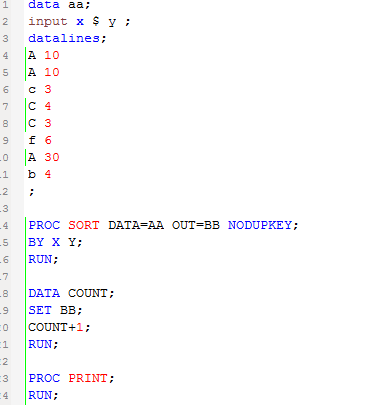
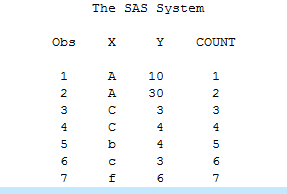
Result:


- Mark as New
- Bookmark
- Subscribe
- Mute
- RSS Feed
- Permalink
- Report Inappropriate Content
Interesting idea, i would replace the counting data-step with proc means or with a query selecting nobs from sashelp.vtable. Would be interesting to see which soiution is more efficient when large datasets are involved.


- Mark as New
- Bookmark
- Subscribe
- Mute
- RSS Feed
- Permalink
- Report Inappropriate Content
@dancy0824 Please post code as text, best is in a code box using the forum {i} menu icon or the SAS run icon.
Pictures that require others to retype the code discourage actually testing/using the code.

Catch up on SAS Innovate 2026
Nearly 200 sessions are now available on demand in the Innovate Hub.
Watch Now →Learn how use the CAT functions in SAS to join values from multiple variables into a single value.

Find more tutorials on the SAS Users YouTube channel.
SAS Training: Just a Click Away
Ready to level-up your skills? Choose your own adventure.
-
5 replies
-
08-02-2017 09:54 AM
-
4313 views
-
4 likes
-
5 in conversation
-


