- Home
- /
- Programming
- /
- Programming
- /
- Re: How can I convert a table with one row to a table with multiple ro...
- RSS Feed
- Mark Topic as New
- Mark Topic as Read
- Float this Topic for Current User
- Bookmark
- Subscribe
- Mute
- Printer Friendly Page


- Mark as New
- Bookmark
- Subscribe
- Mute
- RSS Feed
- Permalink
- Report Inappropriate Content
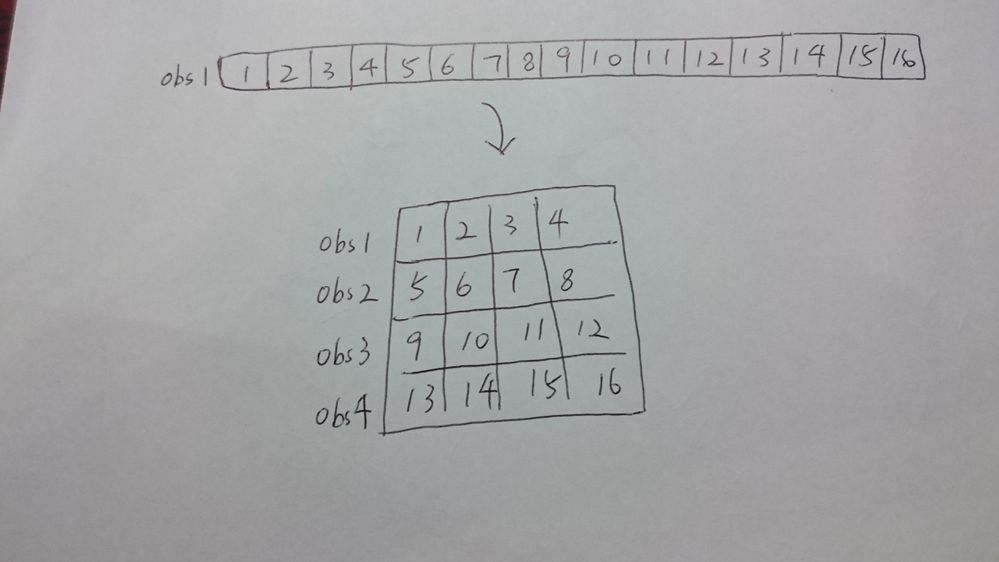
Can I convert the data in a table with one row to a table with multiple rows? What are their coding?
Original table:
1 2 3 4 5 6 7 8 9 10 11 12 13 14 15 16
Table that I want:
1 2 3 4
5 6 7 8
9 10 11 12
13 14 15 16
Accepted Solutions


- Mark as New
- Bookmark
- Subscribe
- Mute
- RSS Feed
- Permalink
- Report Inappropriate Content
In this case an Array is probably your best bet, with an explicit OUTPUT statement. Here's a quick example with two loops.
data want;
set have;

array vals(*) val1-val16;
array new(*) new1-new4;

do i=1 to 4;

    do j=1 to 4;
         new(j) = vals(j*i);
    end;

output;

end;
run;
@Jonathanzz wrote:
Can I convert the data in a table with one row to a table with multiple rows? What are their coding?
Original table:
1 2 3 4 5 6 7 8 9 10 11 12 13 14 15 16
Table that I want:
1 2 3 4
5 6 7 8
9 10 11 12
13 14 15 16


- Mark as New
- Bookmark
- Subscribe
- Mute
- RSS Feed
- Permalink
- Report Inappropriate Content
data have;
  input var1-var4 @@;
  cards;
1 2 3 4 5 6 7 8 9 10 11 12 13 14 15 16
;
Art, CEO, AnalystFinder.com
- Mark as New
- Bookmark
- Subscribe
- Mute
- RSS Feed
- Permalink
- Report Inappropriate Content
In this case an Array is probably your best bet, with an explicit OUTPUT statement. Here's a quick example with two loops.
data want;
set have;

array vals(*) val1-val16;
array new(*) new1-new4;

do i=1 to 4;

    do j=1 to 4;
         new(j) = vals(j*i);
    end;

output;

end;
run;
@Jonathanzz wrote:
Can I convert the data in a table with one row to a table with multiple rows? What are their coding?
Original table:
1 2 3 4 5 6 7 8 9 10 11 12 13 14 15 16
Table that I want:
1 2 3 4
5 6 7 8
9 10 11 12
13 14 15 16
- Mark as New
- Bookmark
- Subscribe
- Mute
- RSS Feed
- Permalink
- Report Inappropriate Content


- Mark as New
- Bookmark
- Subscribe
- Mute
- RSS Feed
- Permalink
- Report Inappropriate Content
I guess that one way for this approach would be:
data want (keep = new1-new4);
set have;
array vals(*) var1-var16;
array new(*) new1-new4;

do j = 1 to floor(dim(vals)/4);
  do i = 1 to 4;
    new(i) = vals((j-1)*4 + i);
  end;
  output;
end;
run;
- Mark as New
- Bookmark
- Subscribe
- Mute
- RSS Feed
- Permalink
- Report Inappropriate Content
It is very easy for IML code.
data have;
  input var1-var4 @@;
  cards;
1 2 3 4 5 6 7 8 9 10 11 12 13 14 15 16
;

proc iml;
use have;
read all var _all_ into x;
close;

want=shape(x,0,4);

create want from want;
append from want;
close;
quit;

- Mark as New
- Bookmark
- Subscribe
- Mute
- RSS Feed
- Permalink
- Report Inappropriate Content
I would probably
1. add a new observation with values like 1,2,3,4,1,2,3,4,1,2,3,4,....
2. use Proc Transpose
When your dataset is large, this can be super efficiant by avoiding loops.

Call for content now open!
It's your turn to help shape SAS Innovate 2027. Share your expertise and inspire the SAS community.
Learn how use the CAT functions in SAS to join values from multiple variables into a single value.

Find more tutorials on the SAS Users YouTube channel.
SAS Training: Just a Click Away
Ready to level-up your skills? Choose your own adventure.
-
6 replies
-
04-12-2017 12:59 PM
-
4575 views
-
6 likes
-
6 in conversation
-


