- Home
- /
- Programming
- /
- SAS Procedures
- /
- Re: linear interpolation of missing data
- RSS Feed
- Mark Topic as New
- Mark Topic as Read
- Float this Topic for Current User
- Bookmark
- Subscribe
- Mute
- Printer Friendly Page


- Mark as New
- Bookmark
- Subscribe
- Mute
- RSS Feed
- Permalink
- Report Inappropriate Content
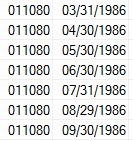
Hallo, I have a timeserie but there are missing value at the beginning. How can I do a linear interpolation for those missing value? Thank you!
id date value



- Mark as New
- Bookmark
- Subscribe
- Mute
- RSS Feed
- Permalink
- Report Inappropriate Content
If you have SAS ETS you could use proc expand. e.g.:
data have;
informat date mmddyy10.;
format date mmddyy10.;
input id $ date value;
cards;
011080 3/31/1986 317.607
011080 4/30/1986 .
011080 5/30/1986 .
011080 6/30/1986 452.600
011080 7/31/1986 .
011080 8/29/1986 .
011080 9/30/1986 568.433
;
proc sort data=have;
by date;
run;
proc expand data=have out=LinInterp;
convert value=linear / method=join;
id date;
run;
- Mark as New
- Bookmark
- Subscribe
- Mute
- RSS Feed
- Permalink
- Report Inappropriate Content
I only have sas 9.2 it did not work.
- Mark as New
- Bookmark
- Subscribe
- Mute
- RSS Feed
- Permalink
- Report Inappropriate Content
It should have worked (I think) in 9.2, but you would have to have licensed SAS/ETS.
- Mark as New
- Bookmark
- Subscribe
- Mute
- RSS Feed
- Permalink
- Report Inappropriate Content
Rick's blog provides links for accomplishing the task at least 3 different ways, ETS, IML and a data step. If you don't have either ETS or IML licensed, you should be able to incorporate the datastep solution. see: Linear interpolation in SAS - The DO Loop
- Mark as New
- Bookmark
- Subscribe
- Mute
- RSS Feed
- Permalink
- Report Inappropriate Content
Thank you.


- Mark as New
- Bookmark
- Subscribe
- Mute
- RSS Feed
- Permalink
- Report Inappropriate Content
Hi.
If you want to "linearly" impute the data then you can do a proc reg on your data, save the linear equation, then calculate the missing values.
Something like this:
*using the data you have, I create "order" variable which is really just 1..n;
data have;
set have;
order = _n_;
run;
*run a linear regression to get the parameters for the line;
proc reg data = have;
model value = order;
ods output parameterEstimates = est(keep = variable estimate);
run;quit;
*save the intercept and the beta;
data _null_;
set est;
if variable = "Intercept" then do;
call symput ("int", estimate);
end;
if variable = "order" then do;
call symput ("beta", estimate);
end;
run;
data want;
set have;
if value = . then value = &int. + order * &beta.;
run;
Good luck!
- Mark as New
- Bookmark
- Subscribe
- Mute
- RSS Feed
- Permalink
- Report Inappropriate Content
Thanks!!

Call for content now open!
It's your turn to help shape SAS Innovate 2027. Share your expertise and inspire the SAS community.
Learn the difference between classical and Bayesian statistical approaches and see a few PROC examples to perform Bayesian analysis in this video.

Find more tutorials on the SAS Users YouTube channel.
SAS Training: Just a Click Away
Ready to level-up your skills? Choose your own adventure.
-
7 replies
-
11-24-2012 08:20 AM
-
7133 views
-
6 likes
-
3 in conversation
-

