- Home
- /
- Programming
- /
- SAS Procedures
- /
- Re: Suming - do I use proc sql?
- RSS Feed
- Mark Topic as New
- Mark Topic as Read
- Float this Topic for Current User
- Bookmark
- Subscribe
- Mute
- Printer Friendly Page


- Mark as New
- Bookmark
- Subscribe
- Mute
- RSS Feed
- Permalink
- Report Inappropriate Content
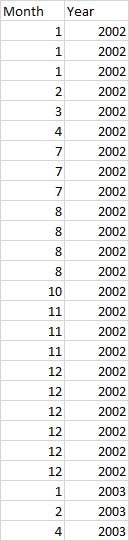
I have a data set that looks like the following.I want to sum Month by for each year. Some months have no data not sure how to enter a 0 for those months that don't exist. Any thoughts appreciated.
For instance I want a table that has the following:
Month Year
Month Sum Year
1 3 2002
2 1 2002
3 1 2002
4 1 2002
5 0 2002
6 0 2002
7 3 2002
etc...
Data looks like:

- Mark as New
- Bookmark
- Subscribe
- Mute
- RSS Feed
- Permalink
- Report Inappropriate Content
Dear User,
Please find the solution as under:
/*
showing monthly cumulatives*/
data monthly;
input month year;
cards;
1 2002
1 2002
1 2002
2 2002
3 2002
7 2002
7 2002
7 2002
7 2002
1 2003
2 2003
;
run;
proc sort data = monthly; by month year; run;
data month_c;
set monthly ;
by month year;
retain cnt;
if first.year then cnt =1 ;
else cnt +1;
if last.year then output;
run;


- Mark as New
- Bookmark
- Subscribe
- Mute
- RSS Feed
- Permalink
- Report Inappropriate Content
proc summary missing data= your.data nway ;
class year month;
Output out= results( drop= _type_ ) ;
run;
However that won't provide a 0 for months with no data.
I think there is an option of the procedure to provide that csllef COMPLETETYPES
Good luck
peterC


- Mark as New
- Bookmark
- Subscribe
- Mute
- RSS Feed
- Permalink
- Report Inappropriate Content
Try using the sparse option with a proc freq. That should generate the zero's as well.
proc freq data=have;
table month*year/out=want sparse;
run;

- Mark as New
- Bookmark
- Subscribe
- Mute
- RSS Feed
- Permalink
- Report Inappropriate Content
You need to make a dummy dataset to hold all of year and month .
data have;
input month year;
cards;
1 2002
1 2002
1 2002
2 2002
3 2002
7 2002
7 2002
7 2002
7 2002
1 2003
2 2003
;
run;
proc sort data=have(keep=year) out=year nodupkey;by year;run;
data temp;
 set year;
 do month=1 to 12;
  output;
 end;
run;
proc sql;
create table want as
select a.*,coalesce(b.sum,0) as sum
 from temp as a  left join
( select year,month,count(*) as sum
  from have
   group by year,month)     as b
  on a.year=b.year and a.month=b.month ;
quit;
Xia Keshan

Call for content now open!
It's your turn to help shape SAS Innovate 2027. Share your expertise and inspire the SAS community.
Learn the difference between classical and Bayesian statistical approaches and see a few PROC examples to perform Bayesian analysis in this video.
Find more tutorials on the SAS Users YouTube channel.
SAS Training: Just a Click Away
Ready to level-up your skills? Choose your own adventure.
-
4 replies
-
07-05-2014 01:25 AM
-
3272 views
-
0 likes
-
5 in conversation
-


