- Home
- /
- Programming
- /
- SAS Procedures
- /
- Re: Do you have any idea for adding last(or maximum) value?
- RSS Feed
- Mark Topic as New
- Mark Topic as Read
- Float this Topic for Current User
- Bookmark
- Subscribe
- Mute
- Printer Friendly Page


- Mark as New
- Bookmark
- Subscribe
- Mute
- RSS Feed
- Permalink
- Report Inappropriate Content
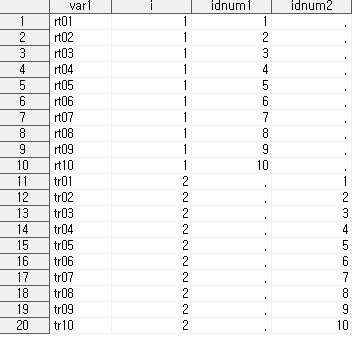
used code
-----------------------------------------------------------------------------------------------
data tp;
set p ;
i=index(var1,'r') ;
if i=1 then do idnum1=input(compress(var1, ' ', 'A'), 5.) ;
end;
if i=2 then do idnum2=input(compress(var1, ' ', 'A'), 5.) ;
end;
run;
-----------------------------------------------------------------------------------------------
I want to make new variable(idnum3) from this dataset.
How could I make 'idnum3' 1 to 20 using last observation of 'idnum1' add to 'idnum2'.
If you have any idea please tell me.
thank you.


- Mark as New
- Bookmark
- Subscribe
- Mute
- RSS Feed
- Permalink
- Report Inappropriate Content
data have;
input var1 $;
i=index(var1,'r');
if i=1 then idnum1=input(compress(var1, ' ', 'A'), 5.) ;
if i=2 then idnum2=input(compress(var1, ' ', 'A'), 5.) ;
datalines;
rt01
rt02
rt03
rt04
rt05
rt06
rt07
rt08
rt09
rt10
tr01
tr02
tr03
tr04
tr05
tr06
tr07
tr08
tr09
tr10
;
proc sql;
select max(idnum1) into :max from have;
quit;
data want;
set have;
idnum3=sum(&max,idnum2);
run;


- Mark as New
- Bookmark
- Subscribe
- Mute
- RSS Feed
- Permalink
- Report Inappropriate Content
Assuming that the portion of code that you posted is working as intended, you could add to the same DATA step:
retain last_idnum1;
if idnum1 > . then do;
idnum3 = idnum1;
last_idnum1 = idnum1;
end;
else idnum3 = sum(last_idnum1, idnum2);
Good luck.


- Mark as New
- Bookmark
- Subscribe
- Mute
- RSS Feed
- Permalink
- Report Inappropriate Content
And if you want a simple row counter, assuming you may have more data
add
idnum3 = _n_; to the same data step.

Catch up on SAS Innovate 2026
Nearly 200 sessions are now available on demand in the Innovate Hub.
Watch Now →Learn the difference between classical and Bayesian statistical approaches and see a few PROC examples to perform Bayesian analysis in this video.
Find more tutorials on the SAS Users YouTube channel.
SAS Training: Just a Click Away
Ready to level-up your skills? Choose your own adventure.
-
3 replies
-
08-16-2014 03:47 AM
-
2021 views
-
0 likes
-
4 in conversation
-


