- Home
- /
- Programming
- /
- SAS Procedures
- /
- Create multiple cumulative subtotals
- RSS Feed
- Mark Topic as New
- Mark Topic as Read
- Float this Topic for Current User
- Bookmark
- Subscribe
- Mute
- Printer Friendly Page


- Mark as New
- Bookmark
- Subscribe
- Mute
- RSS Feed
- Permalink
- Report Inappropriate Content
Hello All,
I have this dataset:
| Case | Amount | Need1 | Need2 | Need3 |
| 1 | 30 | 20 | 15 | 10 |
| 2 | 12 | 20 | 15 | 10 |
| 3 | 10 | 20 | 15 | 10 |
| 4 | 8 | 20 | 15 | 10 |
| 5 | 5 | 20 | 15 | 10 |
| 6 | 2 | 20 | 15 | 10 |
And need your help to obtain Cumulative_subtotal and Cumulative_subtotal_id fields:
| Case | Amount | Need1 | Need2 | Need3 | Cumulative_subtotal | Cumulative_subtotal_id |
| 1 | 30 | 20 | 15 | 10 | 30 | 1 |
| 2 | 12 | 20 | 15 | 10 | 12 | 2 |
| 3 | 10 | 20 | 15 | 10 | 22 | 2 |
| 4 | 8 | 20 | 15 | 10 | 8 | 3 |
| 5 | 5 | 20 | 15 | 10 | 13 | 3 |
| 6 | 2 | 20 | 15 | 10 | 2 | 0 |
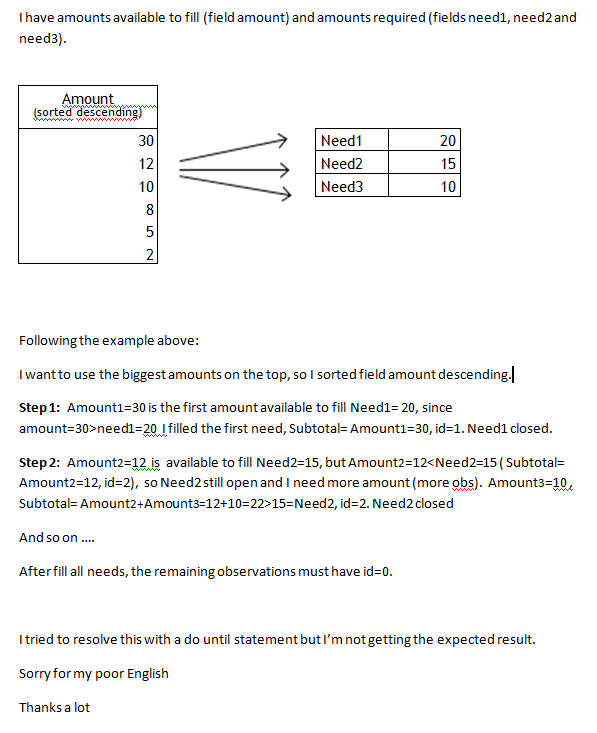
Create multiple cumulative subtotals of amount that cover/hedge Needi.
Cumulative_subtotal=30>=Need1=20 end of id=1;
Cumulative_subtotal=22>=Need2=15 end of id=2;
Cumulative_subtotal=13>=Need3=10 end of id=3;
Cumulative_subtotal_id=0 means not needed.
Thank you for your help,
Accepted Solutions


- Mark as New
- Bookmark
- Subscribe
- Mute
- RSS Feed
- Permalink
- Report Inappropriate Content
Your explanation helps. Here is one possibility.
data want;
cumulative_subtotal=0;
retain cumulative_subtotal_id 1;
array need {3} ;
if cumulative_subtotal_id = 0 then total_need = 9999999999999999;
else total_need = need{cumulative_subtotal_id};
do until (cumulative_subtotal >= total_need);
set have;
cumulative_subtotal + amount;
output;
end;
cumulative_subtotal_id + 1;
if cumulative_subtotal_id > 3 then cumulative_subtotal_id=0;
run;
It's untested code, so you may need to tweak it. But it should have enough working pieces. Usually when a program is this clunky there is an easier way. I'm just not seeing it right now.
Good luck.

- Mark as New
- Bookmark
- Subscribe
- Mute
- RSS Feed
- Permalink
- Report Inappropriate Content
Could you please explain your problem a bit more.
what is cove/hedge etc..
Please put some usuable sample data
- Mark as New
- Bookmark
- Subscribe
- Mute
- RSS Feed
- Permalink
- Report Inappropriate Content
More details:


- Mark as New
- Bookmark
- Subscribe
- Mute
- RSS Feed
- Permalink
- Report Inappropriate Content
What in the data tells that an id group is starting or ending?
- Mark as New
- Bookmark
- Subscribe
- Mute
- RSS Feed
- Permalink
- Report Inappropriate Content
An id identifies a subtotal: amounts that fill needi must have id=i. The id=i ends when amount is no longer required for fill needi.
Thanks
- Mark as New
- Bookmark
- Subscribe
- Mute
- RSS Feed
- Permalink
- Report Inappropriate Content
Your explanation helps. Here is one possibility.
data want;
cumulative_subtotal=0;
retain cumulative_subtotal_id 1;
array need {3} ;
if cumulative_subtotal_id = 0 then total_need = 9999999999999999;
else total_need = need{cumulative_subtotal_id};
do until (cumulative_subtotal >= total_need);
set have;
cumulative_subtotal + amount;
output;
end;
cumulative_subtotal_id + 1;
if cumulative_subtotal_id > 3 then cumulative_subtotal_id=0;
run;
It's untested code, so you may need to tweak it. But it should have enough working pieces. Usually when a program is this clunky there is an easier way. I'm just not seeing it right now.
Good luck.
- Mark as New
- Bookmark
- Subscribe
- Mute
- RSS Feed
- Permalink
- Report Inappropriate Content
Astounding,
Thank you for your help. Works perfectly in my example  . I just did a very small adjustment for cases when I have Needi=0 (ex. Need2=0, no amount is necessary to fill).

Call for content now open!
It's your turn to help shape SAS Innovate 2027. Share your expertise and inspire the SAS community.
Learn the difference between classical and Bayesian statistical approaches and see a few PROC examples to perform Bayesian analysis in this video.
Find more tutorials on the SAS Users YouTube channel.
SAS Training: Just a Click Away
Ready to level-up your skills? Choose your own adventure.
-
6 replies
-
10-19-2013 06:16 PM
-
4020 views
-
1 like
-
4 in conversation
-


