- Home
- /
- Programming
- /
- Programming
- /
- Subsetting
- RSS Feed
- Mark Topic as New
- Mark Topic as Read
- Float this Topic for Current User
- Bookmark
- Subscribe
- Mute
- Printer Friendly Page


- Mark as New
- Bookmark
- Subscribe
- Mute
- RSS Feed
- Permalink
- Report Inappropriate Content
I have a long (i.e., not wide) dataset w/ 3 timepoints per participant:
| baseline_arm_1 |
| fu_1_arm_1 |
| fu_2_arm_1 |
I want to create a subset that only includes those who have completed all 3 timepoints. In the image below, the orange rows would be included and the yellow rows would be excluded.
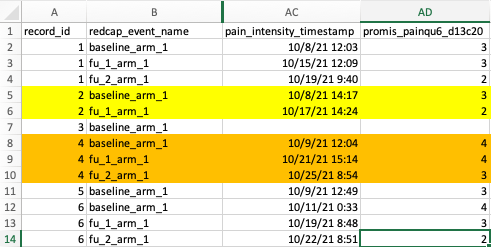
I've tried various version of subsetting using WHERE, IN, OR, AND, etc.
Seems like it should be pretty straight forward, but I can't figure it out.
Thanks.


- Mark as New
- Bookmark
- Subscribe
- Mute
- RSS Feed
- Permalink
- Report Inappropriate Content
It is complicated because you essentially need to process the data for each participant twice. Once to check if all three events occurred and a second time to decide whether to output them.
You could do that in a data step using two DO loops.
data want;
  do until(last.participant);
    set have;
    by participant;
    if redcap_event_name='baseline_arm_1' then baseline=1;
    if redcap_event_name='fu_arm_1' then fu1=1;
    if redcap_event_name='fu_arm_2' then fu2=1;
  end;
  do until(last.participant);
    set have;
    by participant;
    if baseline and fu1 and fu2 then output;
  end;
run;

- Mark as New
- Bookmark
- Subscribe
- Mute
- RSS Feed
- Permalink
- Report Inappropriate Content
/* UNTESTED CODE */
proc freq data=have;
    tables record_id/out=counts;
run;
data want;
    merge have counts;
    by record_id;
    if count=3;
run;
If you want tested code, please supply the data (not as a screen capture, we can't test code against a screen capture) but as SAS data step code, which you can type yourself or use these instructions. And you should provide data this way in your future questions.
Paige Miller

- Mark as New
- Bookmark
- Subscribe
- Mute
- RSS Feed
- Permalink
- Report Inappropriate Content
proc sql;
create table want as
select * from have
where record_id in (select record_id from have group by record_id having count (distinctr edcap_event_name) =3)
order by 1, 2;
quit;


- Mark as New
- Bookmark
- Subscribe
- Mute
- RSS Feed
- Permalink
- Report Inappropriate Content
Assuming that the desired complete sets always occur in the sequence
baseline_arm_1
fu_1_arm_1
fu_1_arm_2
you can do a "lookahead" merge to determine whether the current record and the two subsequent records should be output (untested)::
data want (drop=_:);

  merge have
        have (firstobs=2 keep=redcap_event_name rename=(redcap_event_name=_nxt_evnt))
        have (firstobs=3 keep=participant redcap_event_name rename=(participant=_nxt_part2 redcap_event_name=_nxt_evnt2));

  retain _counter 0;
  if _counter<=0 then do;  /*If not already in a threesome, then check the lookaheads */
    if redcap_event_name='baseline_arm_1'  and _nxt_evnt='fu_1_arm_1'  and _nxt_evnt2='fu_2_arm_2'
       and _nxtpart2=participant then _counter=3;
  end;

  if _counter>0;
  _counter+(-1);
run;
Editted note: slightly cleaner code below:
data want (drop=_:);

  merge have
        have (firstobs=2 keep=redcap_event_name rename=(redcap_event_name=_nxt_evnt))
        have (firstobs=3 keep=participant redcap_event_name rename=(participant=_nxt_part2 redcap_event_name=_nxt_evnt2));

  retain _counter 0;
  if redcap_event_name='baseline_arm_1' then do;  /*If this is baseline, check the lookaheads */
     if _nxt_evnt='fu_1_arm_1'  and _nxt_evnt2='fu_2_arm_2' and _nxtpart2=participant then _counter=3;
  end;

  if _counter>0;
  _counter+(-1);
run;The hash OUTPUT method will overwrite a SAS data set, but not append. That can be costly. Consider voting for Add a HASH object method which would append a hash object to an existing SAS data set
Would enabling PROC SORT to simultaneously output multiple datasets be useful? Then vote for
Allow PROC SORT to output multiple datasets
--------------------------

Call for content now open!
It's your turn to help shape SAS Innovate 2027. Share your expertise and inspire the SAS community.
Learn how use the CAT functions in SAS to join values from multiple variables into a single value.

Find more tutorials on the SAS Users YouTube channel.
SAS Training: Just a Click Away
Ready to level-up your skills? Choose your own adventure.
-
4 replies
-
05-26-2022 12:35 PM
-
2280 views
-
4 likes
-
5 in conversation
-


