Turn on suggestions
Auto-suggest helps you quickly narrow down your search results by suggesting possible matches as you type.
Showing results for
Options
- RSS Feed
- Mark Topic as New
- Mark Topic as Read
- Float this Topic for Current User
- Bookmark
- Subscribe
- Mute
- Printer Friendly Page


Fluorite | Level 6
- Mark as New
- Bookmark
- Subscribe
- Mute
- RSS Feed
- Permalink
- Report Inappropriate Content
Posted 11-20-2017 11:58 AM
(2460 views)
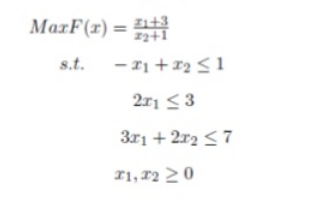
If we have this problem (you can see it in https://www.slideshare.net/orajjournal/a-single-stage-single-constraints-linear-fractional-programmi...), can we solve with SAS?
3 REPLIES 3


Opal | Level 21
- Mark as New
- Bookmark
- Subscribe
- Mute
- RSS Feed
- Permalink
- Report Inappropriate Content
There are a number ways. Take a look at: https://blogs.sas.com/content/iml/2016/12/19/solve-linear-programming-problems-sas.html
Art, CEO, AnalystFinder.com


SAS Super FREQ
- Mark as New
- Bookmark
- Subscribe
- Mute
- RSS Feed
- Permalink
- Report Inappropriate Content
Here are three ways:
/* linear fractional programming problem (NLP) */
proc optmodel;
   var x {1..2} >= 0;
   max z = (x[1] + 3) / (x[2] + 1);
   con c1: -x[1] + x[2] <= 1;
   con c2: 2*x[1] <= 3;
   con c3: 3*x[1] + 2*x[2] <= 7;
   solve;
   print x;
quit;

/* linear programming transformation from Das/Mandal paper (LP) */
proc optmodel;
   var y {1..2} >= 0;
   max z = y[1] - y[2] + 3;
   con c1: -y[1] + 2*y[2] <= 1;
   con c2: 2*y[1] <= 3;
   con c3: 3*y[1] + 9*y[2] <= 7;
   solve;
   print y;
quit;

/* linear programming problem from Charnes/Cooper transformation (LP) */
/* https://en.wikipedia.org/wiki/Linear-fractional_programming#Transformation_to_a_linear_program */
proc optmodel;
   var y {1..2} >= 0;
   var t >= 0;
   max z = y[1] + 3*t;
   con c1: -y[1] + y[2] <= t;
   con c2: 2*y[1] <= 3*t;
   con c3: 3*y[1] + 2*y[2] <= 7*t;
   con c4: y[2] + t = 1;
   solve;
   print y;
   impvar x {j in 1..2} = y[j].sol / t.sol;
   print x;
quit;


Super User
- Mark as New
- Bookmark
- Subscribe
- Mute
- RSS Feed
- Permalink
- Report Inappropriate Content
SAS/IML also can do that . If you want IML solution, post it at IML forum. Rick is there.

Catch up on SAS Innovate 2026
Nearly 200 sessions are now available on demand with the SAS Innovate Digital Pass.
Explore Now →
Upcoming Events
- Ask the Expert: Advanced Data Collection and Insights in SAS Customer Intelligence 360 | 28-May-2026
- Spring 2026 OASUS Meeting | 28-May-2026
- Spring 2026 ESUG Meeting - Social Celebration | 02-Jun-2026
- Spring 2026 ESUG Meeting | 03-Jun-2026
Discussion stats
-
3 replies
-
11-20-2017 11:58 AM
-
2461 views
-
0 likes
-
4 in conversation
-


